Short wave (SW)
0.8–1.6 µm. Full output in about one second, so the loop can follow a moving web. The default for printing, sintering and thin films.
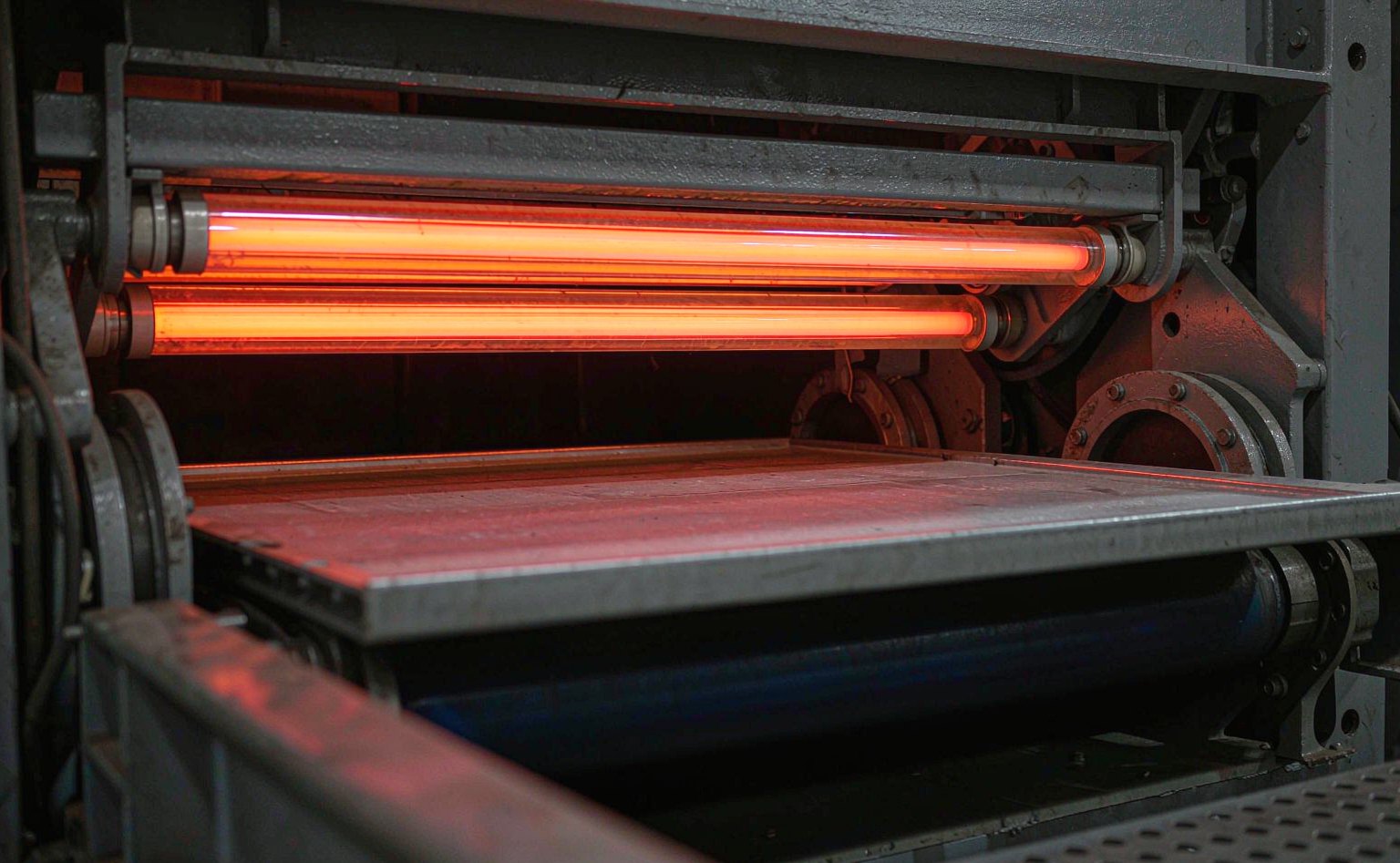
0.8 – 2.7 µm · single & twin tube
Four wavelength families, two tube constructions, three reflector options — and about ten internal ways to build a twin tube. Most of what we ship is made to a sample or a drawing, so treat the tables on this page as the standard grid, not the limit.
Physics, briefly
A 1.2 µm short-wave emitter pushes energy through most polymers and into the substrate; a 3 µm medium-wave emitter is absorbed in the first few micrometres and heats the surface. Choosing the wrong one is the usual reason an oven ends up twice the length it needs to be.
Short-wave filaments reach full output in under two seconds and cool just as fast — the loop can follow a moving web without overshoot.
Our envelopes hold transmission above 90% after 5,000 h at 1,000 °C — no devitrification haze eating your power budget.
Gold, white ceramic or polished aluminium coatings shaped to your working distance, with less than 8% stray loss at 150 mm.
The four families
What matters is how deeply the radiation is absorbed by the material you are heating. Short wave goes through most polymers and heats the body; medium wave is absorbed in the first few micrometres and heats the surface.
0.8–1.6 µm. Full output in about one second, so the loop can follow a moving web. The default for printing, sintering and thin films.
About 1.8 µm — between short and medium. We build these up to 4.2 m, which is what wide glass and film lines need.
2.0–2.7 µm, about 60 seconds to full response. Longer life and a gentler surface load — the workhorse for powder coating and preheating.
Fast reaction, high intensity and a more even spread across the heated surface — useful where a sharp hot spot would mark the product.
Tube geometry
A twin tube puts the filament at one focus and a gold coating at the other, so more of the energy arrives where you aimed it. A single tube is cheaper, faster to replace and often enough when the chamber is closed.
| Diameter | Max length | Typical use |
|---|---|---|
| 10 mm | 1,200 mm | Small ovens, replacement lamps |
| 12 mm | 2,500 mm | Printing, drying tunnels |
| 15 mm | 3,000 mm | Coating, preheating |
| 18 mm | 3,500 mm | Wide web, glass |
| 20 mm | 4,000 mm | High power, long spans |
| Section | Max length | Typical use |
|---|---|---|
| 18 × 9 mm | 1,000 mm | Compact modules, lab ovens |
| 23 × 11 mm | 2,500 mm | Printing, PV stringers |
| 33 × 15 mm | 5,000 mm | Glass, wide furnaces, high power |
Single tubes are also available from 8 mm, and twin tubes in more than ten internal constructions — round filament, flat filament, reflector on one or both sides. End caps and connections are made to your drawing.
Reflectors
The coating decides how much of the radiation reaches the product, and what temperature the lamp itself can survive. It is the cheapest place to fix an inefficient oven.
A gold layer fixed directly on the quartz, reflecting more than 90% of the infrared. With proper cooling it works at about 600 °C.
A white ceramic layer on the tube, reflecting about 70%. Less efficient than gold, but it takes 900–1,000 °C — the choice for hot, dirty chambers.
Used to soften the intensity of the filament, usually applied over the whole tube in combination with another reflector. For heat-sensitive product.
Standard builds
These are lamps we build regularly — useful for a quick price and a reference point. Any other length, wattage or voltage can be made to your drawing; the sample stage is where that gets settled.
| Type | Power | Length | Heating length | Voltage | Diameter | Finish | Life |
|---|---|---|---|---|---|---|---|
| SW | 1,100 W | 480 mm | 254 mm | 240 V | 10 mm | Clear | 3,000 h |
| SW | 1,100 W | 600 mm | 380 mm | 220 V | 10 mm | Clear | 3,000 h |
| SW | 1,500 W | 600 mm | 380 mm | 230 V | 10 mm | Clear | 3,000 h |
| SW | 1,500 W | 750 mm | 550 mm | 230 V | 10 mm | Clear | 3,000 h |
| SW | 1,600 W | 890 mm | 410 mm | 230 V | 10 mm | Clear | 3,000 h |
| SW | 2,000 W | 750 mm | 550 mm | 230 V | 10 mm | Clear | 3,000 h |
| SW | 2,400 W | 1,050 mm | 560 mm | 230 V | 12 mm | Clear | 3,000 h |
| SW | 2,500 W | 890 mm | 580 mm | 230 V | 10 mm | Clear | 3,000 h |
| SW | 3,700 W | 1,050 mm | 560 mm | 230 V | 12 mm | Clear | 3,000 h |
| Type | Power | Length | Heating length | Voltage | Section | Finish | Life |
|---|---|---|---|---|---|---|---|
| SW | 5,800 W | 1,310 mm | 1,162 mm | 480 V | 33×15 | Gold | 5,000 h |
| SW | 7,500 W | 1,360 mm | 1,200 mm | 480 V | 33×15 | Gold | 5,000 h |
| SW | 8,300 W | 3,870 mm | 3,750 mm | 600 V | 33×15 | Gold | 5,000 h |
| SW | 9,500 W | 1,703 mm | 1,508 mm | 480 V | 33×15 | Gold | 5,000 h |
| Carbon | 6,100 W | 1,160 mm | 1,050 mm | 400 V | 33×15 | Gold | 5,000 h |
| MW | 6,400 W | 2,870 mm | 2,740 mm | 480 V | 33×15 | Gold | 10,000 h |
| Type | Power | Length | Heating length | Voltage | Section | Finish | Life |
|---|---|---|---|---|---|---|---|
| SW | 2,000 W | 1,060 mm | 960 mm | 230 V | 23×11 | White | 5,000 h |
| MW | 2,000 W | 1,100 mm | 1,050 mm | 380 V | 23×11 | Gold | 10,000 h |
Voltage is wound to order — 230 V, 380 V, 480 V and 600 V are the common grid values, but other windings are normal. Send the drawing and we will confirm before the sample is built.
IR heating systems
Modules, retrofits, ovens and complete lines. The emitter choice follows from the object: its shape, its absorption, the distance it travels and how fast it has to come up to temperature.
Quartz emitters need only seconds to switch on and off, which shortens the operation time and improves how evenly the material heats up.
Because the emitters start fast, the heat can be concentrated on the zone and the moment it is actually required — not on the surrounding area.
The small section of a quartz emitter simplifies the machine design and makes the heating zone quicker to service.
A photo of the existing lamp with a ruler, or the drawing, is enough for us to come back with type, power and price.